


Why does NOC collect samples from the ocean?
To assess impacts, detect changes, and monitor protected areas in the ocean, NOC undertakes surveys and collects samples for analysis.
We make assessments of changes in biological communities found at a particular point in space and time by surveying the environment in various ways, including documenting the number of specimens of the different species that occur there.

What technology does NOC use to collect samples?
NOC uses state-of-the-art technology to collect samples, imagery, and data to characterise marine biodiversity. This includes:
- World-class oceanographic research vessels
- Remotely operated vehicles (ROVs)
- Autonomous underwater vehicles (AUVs)
- A wide array of specialised sampling equipment
While we can monitor larger megafaunal species using imaging surveys, in many cases, a sample is needed to identify a specimen definitively to the species level. We can make inferences using imagery, but physical samples are often needed, especially for small infaunal species which aren't visible in images.
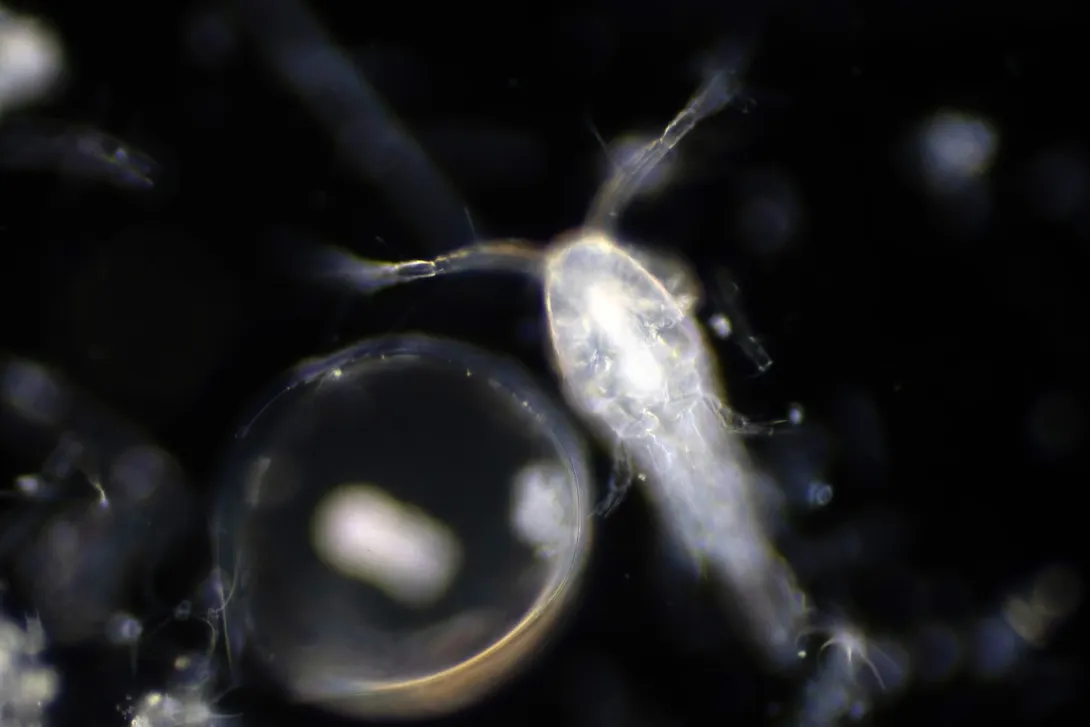
What types of samples does NOC collect?
We collect a wide variety of samples of different components of ocean biodiversity, including:
- Microbes
- Phytoplankton and zooplankton
- Megafauna (larger animals)
- Fauna living both on and in the seabed
Samples are collected from the ocean surface, the water column, and the seafloor (from both sediments and hard rock).
Sampling Equipment and Methods
For collecting neuston and pleuston (organisms living on or near the water surface), we use a neuston net. This is a floating net system specifically designed to collect organisms on, in, or close to the water surface.
For sampling plankton, phytoplankton, zooplankton, and nekton in the water column, we use several types of equipment.
Simple nets such as ring nets (like the WP2 net used at the Porcupine Abyssal Plain) and Bongo nets can be used for simple vertical hauls through the upper water column or actively towed by a ship.
Multi-nets are systems with multiple nets that can be opened and closed on command to sample organisms from different depth horizons in the ocean. Examples include the Rectangular Midwater Trawl system and the MOCNESS (Multiple Opening and Closing Net, with Environmental Sensing System).
Water bottles and pump samplers provide another approach: water bottles close on command, and the enclosed water can then be filtered and examined for organisms. Pump samplers do the filtering in situ (whilst underwater).

Deep-Sea Benthic Sampling
A great many designs exist. Within the National Marine Equipment Pool at NOC, you will find:
- Day Grab - sampling 0.1 m² of seabed to about 10 cm depth
- Multiple Corer and Megacorer - each can collect up to 12 samples of sediment, 5-10 cm in diameter and around 40 cm in depth
- Box Core - sampling 0.25 m² to about 40 cm depth
Such samples are usually sieved on meshes of between 0.05 and 1.00 mm (depending on the target fraction) to recover the organisms within the sediment.
A great many designs exist. The main types used at NOC include:
- OTSB (Otter Trawl Semi Balloon)
- Agassiz Trawl
We have also used other systems in the past, including the Epibenthic sledge.

How do you collect samples from the seabed?
For sampling from hard rock on the seafloor, we use:
- Dredges - equipment designed to scrape along hard substrata and collect specimens.
- Selected samples using ROVs - Remotely operated vehicles can carefully select individual samples which can be removed from the substrata and brought to the surface without damage that might occur from methods like trawling.
Submersibles and remotely operated vehicles can be used to select individual samples which can be carefully removed from the substrata and brought to the surface without damage, for example, avoiding the damage that might occur from a trawl. Baited traps deployed on freefall lander systems are used to capture the mobile scavenger community on the seafloor.

Publications
Several comprehensive book chapters also detail our deep-sea sampling methods, with contributions from NOC authors.
Deep-sea benthic sampling
Jamieson, Alan J.; Boorman, Benjamin; Jones, Daniel O.B.  ORCID: https://orcid.org/0000-0001-5218-1649.
2013
Deep-sea benthic sampling.
In: Eleftheriou, Anastasios, (ed.)
Methods for the study of marine benthos.
Wiley, 285-347.
ORCID: https://orcid.org/0000-0001-5218-1649.
2013
Deep-sea benthic sampling.
In: Eleftheriou, Anastasios, (ed.)
Methods for the study of marine benthos.
Wiley, 285-347.
2013
Book section
Deep-sea benthic sampling
Gage, J.D.; Bett, B.J. ORCID: https://orcid.org/0000-0003-4977-9361.
2005
Deep-sea benthic sampling.
In: Eleftheriou, A.; McIntyre, A., (eds.)
Methods for the study of marine benthos, 3rd ed.
Oxford, UK, Blackwell Science, 273-325, 418pp.
2005
Book section

Interested in learning more?
Learn how species are given universal scientific names so scientists worldwide can study the same organisms.