

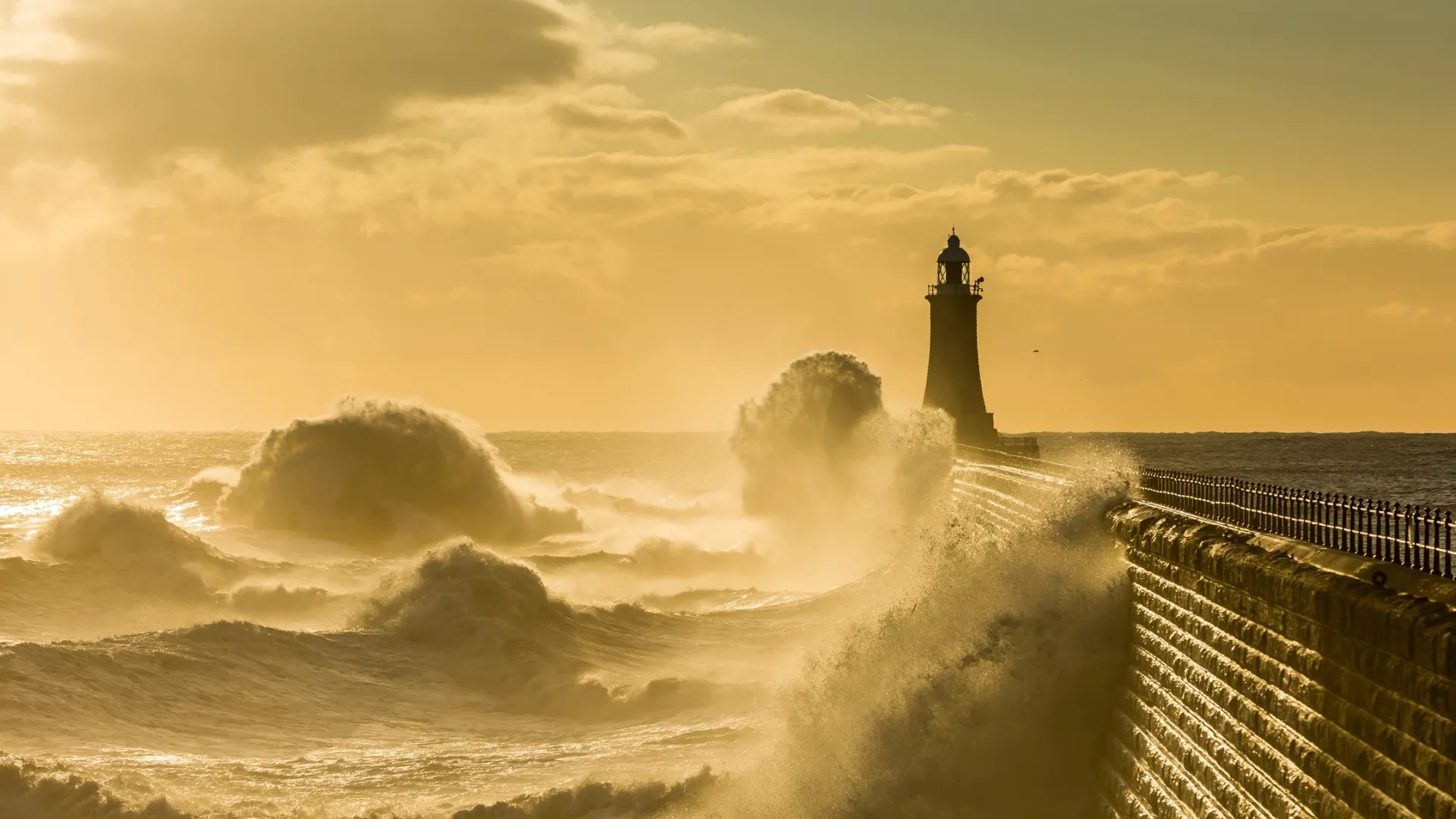
Mitigating the Impacts of Marine-Related Hazards and Pollution
Coastal zones are home to some of the world’s most densely populated areas. These regions rely on the ocean not just for food and livelihoods, but also for essential offshore infrastructure that supports entire industries, global trade and communications.
Impacts of marine hazards and pollution can be devastating - damaging ecosystems, destroying infrastructure, and disrupting lives. Some effects may be irreversible. To better prepare for future disasters, we need an internationally connected community of researchers and decision-makers, supported by new tools and techniques to detect, understand and respond to these events.


Hear From Our Hazards and Pollution Mission Leads
Research into Hazards and Pollution has never been more timely. With one third of the global population living within 50 km of the coast, a growing reliance on the blue economy, and declining ocean health, understanding marine-related hazards and pollution is essential to anticipate, adapt, and build resilience, particularly as their impacts are becoming compounding by the effects of ongoing climate change and changes in human activities."

Hear From Our Hazards and Pollution Mission Leads
NOC’s Hazards & Pollution research provides connections to world-leading capabilities across disciplines, scales, and technologies to avoid future surprise, deliver societal impact, and shape the national and international research agenda. "

Engage with Hazards and Pollution Conversations


Hazards and Pollution Publications
Chen, Peng  ORCID: https://orcid.org/0000-0001-7378-860X; Kane, Ian A.; Clare, Michael A. ORCID: https://orcid.org/0000-0003-1448-3878; Soutter, Euan L.; Mienis, Furu; Wogelius, Roy A.; Keavney, Edward.
2025
Direct evidence that microplastics are transported to the deep sea by turbidity currents.
Environmental Science & Technology, 59 (14).
7278-7287.
10.1021/acs.est.4c12007
ORCID: https://orcid.org/0000-0001-7378-860X; Kane, Ian A.; Clare, Michael A. ORCID: https://orcid.org/0000-0003-1448-3878; Soutter, Euan L.; Mienis, Furu; Wogelius, Roy A.; Keavney, Edward.
2025
Direct evidence that microplastics are transported to the deep sea by turbidity currents.
Environmental Science & Technology, 59 (14).
7278-7287.
10.1021/acs.est.4c12007
2025
Article
Clare, Michael A. ORCID: https://orcid.org/0000-0003-1448-3878; Yeo, Isobel A. ORCID: https://orcid.org/0000-0001-9306-3446; Nash, Jacob; Hunt, James E.; Panuve, Semisi; Wilkie, Alasdair; Williams, Rebecca; Dowey, Natasha; Rowley, Peter; Barclay, Jennifer; Phillips, Jeremy; Scarlett, Jazmin; Engwell, Samantha; Henstock, Timothy J.; Seabrook, Sarah; Watson, Sally; Wysoczanski, Richard; Ribo, Marta; Cronin, Shane; Talling, Peter J.; Cassidy, Michael; Watt, Sebastian; Robertson, Richard.
2025
Volcanic eruptions and the global subsea telecommunications network.
Bulletin of Volcanology, 87 (6).
10.1007/s00445-025-01832-1
2025
Article
Clare, M.A. ORCID: https://orcid.org/0000-0003-1448-3878; Gates, A.R. ORCID: https://orcid.org/0000-0002-2798-5044; Jones, D.O.B. ORCID: https://orcid.org/0000-0001-5218-1649; Yeo, I.A. ORCID: https://orcid.org/0000-0001-9306-3446; Hilario, A.; Van Landeghem, K.J.J. ORCID: https://orcid.org/0000-0002-1040-9956; Harris, L. ORCID: https://orcid.org/0009-0006-9756-5957; Carter, L.; Appleby, S.; Appleby, P.; du Plessis, A.; Logan, M.; Melville, R.; Nguyen, Q. ORCID: https://orcid.org/0009-0006-7711-2221; Calhoun, E.; Fletcher, R.; Wrottesley, J. ORCID: https://orcid.org/0009-0007-4663-9415.
2025
Environmental considerations for the decommissioning of subsea cables.
Journal of Environmental Management, 396, 127962.
1, pp.
10.1016/j.jenvman.2025.127962
2025
Article


Advancing the Frontiers of Research and Innovation: Read the 2025-2035 Strategy
Discover our vision for a healthier, more resilient ocean. This strategy sets out the actions needed to protect marine ecosystems, drive innovation, and secure a sustainable future for everyone.