
British Ambassador Lisa Bandari praises collaboration as NOC and ARDITI mark Autosub Long Range agreement aboard RRS Discovery
The UK’s National Oceanography Centre (NOC) and Madeira Island’s Regional Agency for the Development of Research, Technology and Innovation (ARDITI) have celebrated a landmark collaboration to advance deep-ocean research.
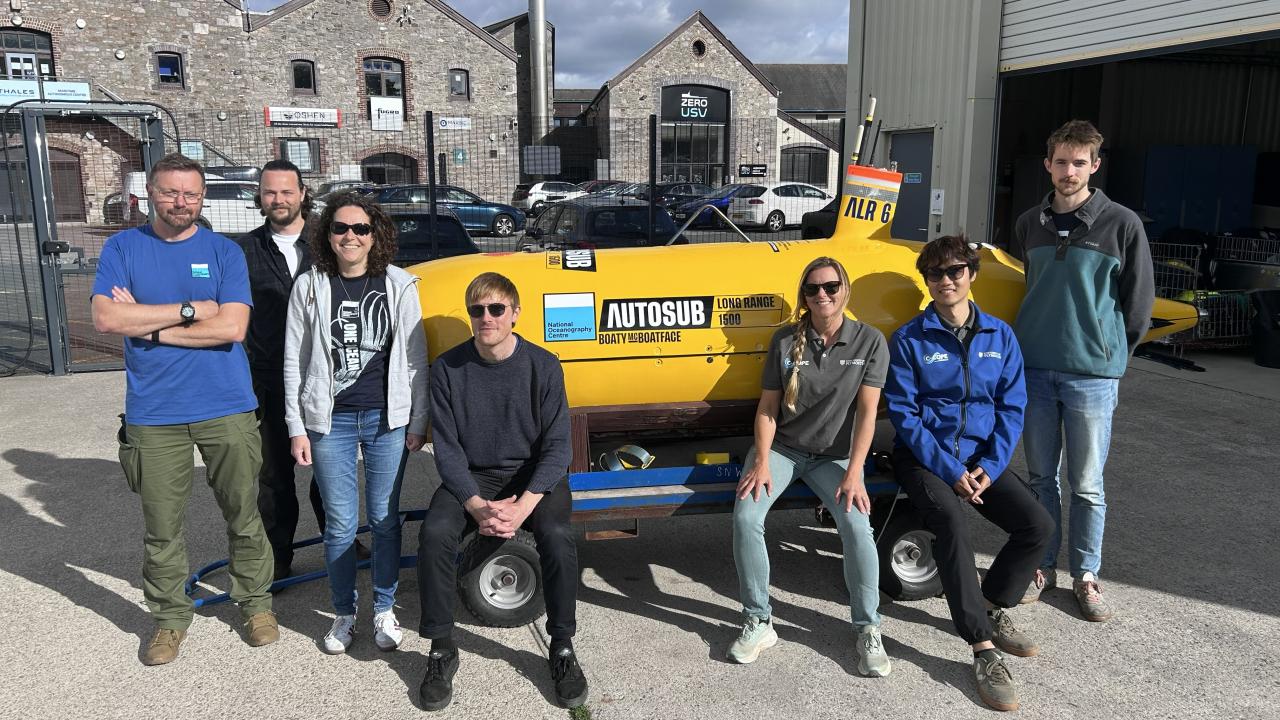
The arrival of RRS Discovery in Madeira marked the acquisition of two state-of-the-art NOC Autosub Long Range (ALR) autonomous underwater vehicles by ARDITI - the first time the technology has been sold internationally.
The visit was attended by Her Majesty’s Ambassador to Portugal, Lisa Bandari, alongside Rui Caldeira, President of ARDITI, and Elsa Fernandes, Madeira’s Regional Secretary for Education and Science, as well as representatives from both organisations.
Speaking at the event, British Ambassador Lisa Bandari said: “This deal and the wider partnership between these two leading institutions is a great example of how we can work together to develop cutting-edge research to preserve the ocean, protect the environment, enhance our security, as well as to promote growth and jobs in our two countries.”
The agreement will see two custom-built ALRs delivered to ARDITI, one rated to 1,500 metres for biogeochemical and oceanographic research, and a second rated to 6,000 metres for seabed mapping. Both vehicles are equipped with a full suite of sensors, providing unprecedented data collection capabilities to support marine science around Madeira and across the Atlantic.
Developed by NOC’s Marine Autonomous and Robotic Systems (MARS) group over nearly three decades, Autosub represents the latest generation of long-range autonomous underwater vehicles. With the ability to operate at depths of up to 6,000 metres for up to three months without a research vessel, the ALR is transforming how scientists observe and understand the global ocean.
The vehicles’ open-source operating system and modular design were key factors in ARDITI’s decision to invest in NOC’s technology.
“It was a priority for us to buy vehicles that are modular and can be customised rather than an off-the-shelf system that can’t be adapted,” said Rui Caldeira, President of ARDITI. “In the future we’ll be able to integrate sensors ourselves with NOC backup and make changes and upgrades to software which can be fed back into the community.”
Daniel Woods, Commercial Development Manager at NOC, added: “It’s very exciting to be able to provide access to this technology to the broader global marine science community. ARDITI are trailblazing this path, becoming the first international customer of our ALR technology.”
The sale marks an important step in NOC’s ambition to build a European network of ALR operators and developers, working together to enhance ocean research, technology sharing, and innovation.
Daniel commented: “We look forward to building on this success, working with other research organisations who see the potential of these vehicles to revolutionise ocean data collection.”
Be part of the community helping our ocean thrive.