
Much of the research going on aboard the RRS James Cook is looking at what animals and microbes live, and how abundant they are, at the seafloor of UK1. The research that I am involved in is putting context to the role of the organisms and how the processes they carry out may be impacted by mining. Consider a restaurant full of people eating dinner. In the same room are insects and microbes and probably plenty of other organisms. As such, the diversity is probably quite high. However, the humans are probably carrying out most of the “ecosystem functions” in the room such as breathing, walking around, etc. The same concept applies to the abyssal seafloor so studying the diversity of organisms as well as what the organisms are doing is important. The experiments I am running are going a step further by simulating a sediment burial event and seeing how the organism functions change upon exposure to burial by seafloor sediments. To do these experiments, I am deploying benthic cubes (seafloor mesocosms) (Figure 1) at the seafloor with the ROV and injecting different amounts of sediment into the cubes. To some cubes, I add a lot of sediment, to others less, and to others no sediment at all.
Stable isotopically labelled organic matter (i.e., food) is then added into each mesocosm which is then incubated at the seafloor for 96hr. After this, we return to the cubes and collect sediment samples which allows us to look at how much organic matter has been eaten by the animals and microbes at the seafloor. By studying organic-matter processing by the seafloor community in the different burial treatments we can see how the sediment burial will affect seafloor ecosystem function, which can help us determine what the impacts of mining may be.
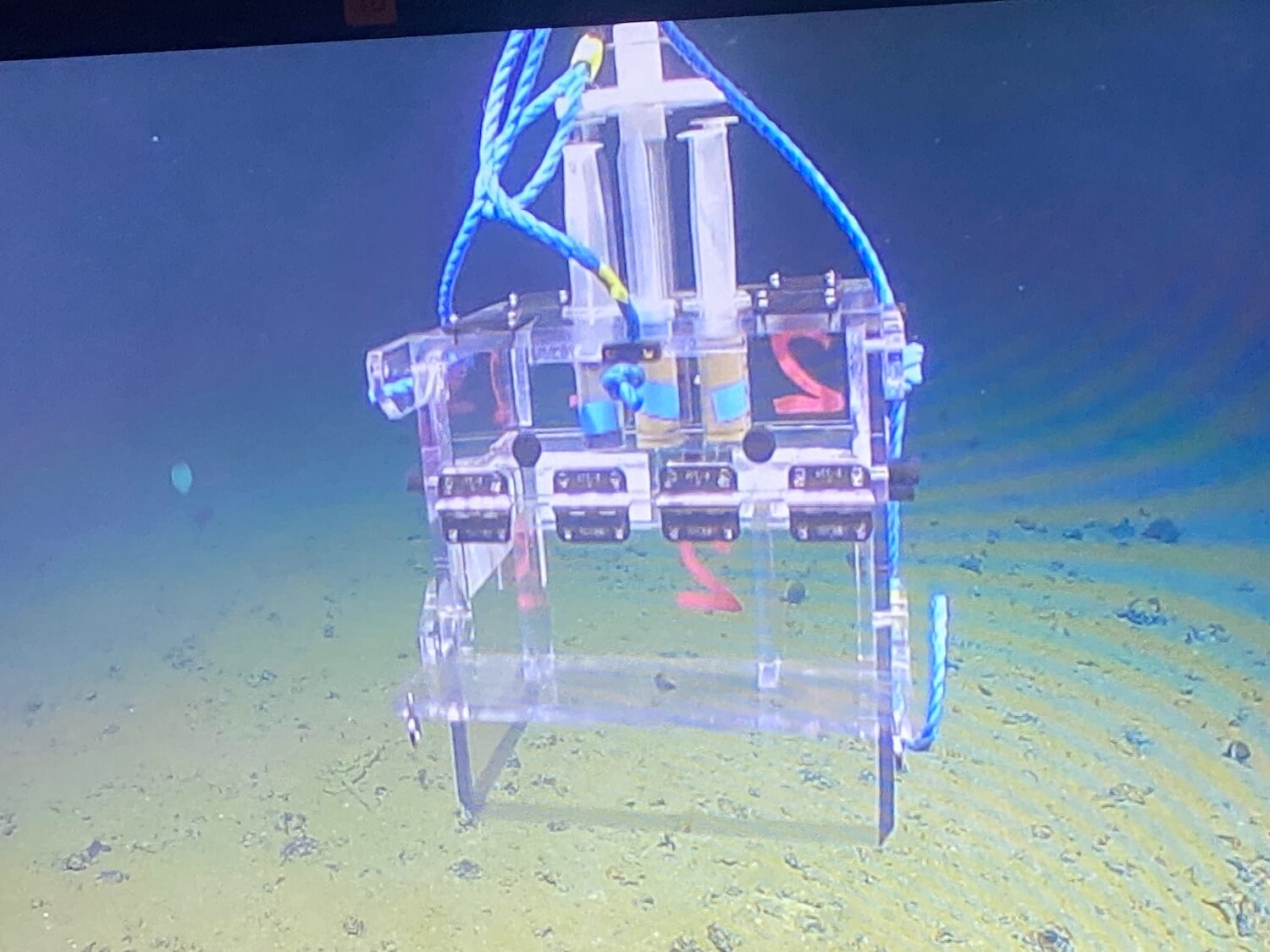
Figure 1. A benthic cube being deployed at the seafloor by the ROV ISIS. In the centre of the image, you can see syringes that have been filled with abyssal sediments that will be released into the cube to simulate sediment being resuspended and then deposited at the seafloor during a mining operation.
Be part of the community helping our ocean thrive.